
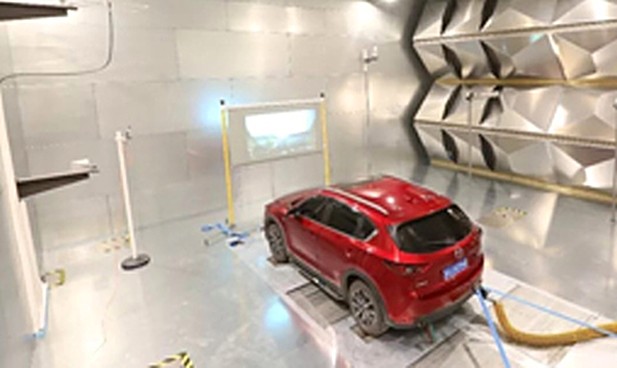
A larger anechoic chamber is not inherently superior, nor should size be reduced merely to economize. The usable space must balance the object under test, the test distance, and the low frequency performance. Absorptive wedges or absorptive walls occupy part of the depth, and the true free field space is the volume that remains once that lining is subtracted.
Low frequency performance is determined principally by the cut off frequency, which is in turn directly related to the thickness of the absorptive structure. To maintain free field behavior down to a lower frequency, a deeper absorber and a larger room are required. Accordingly, at the design stage, the appropriate cut off frequency and clear interior dimensions are established from the frequency range of the product and the applicable test standard.
Test distance is equally significant. Sound power and directivity measurements generally require a prescribed distance between the microphone and the source, with the microphone located within the free field region. A room that is too small forces the measurement points close to the boundaries and introduces reflection error. In designing each laboratory, Anteck first performs the acoustic calculation and then determines the dimensions against both the applicable standard and the site conditions, so that accuracy is assured from the outset.