
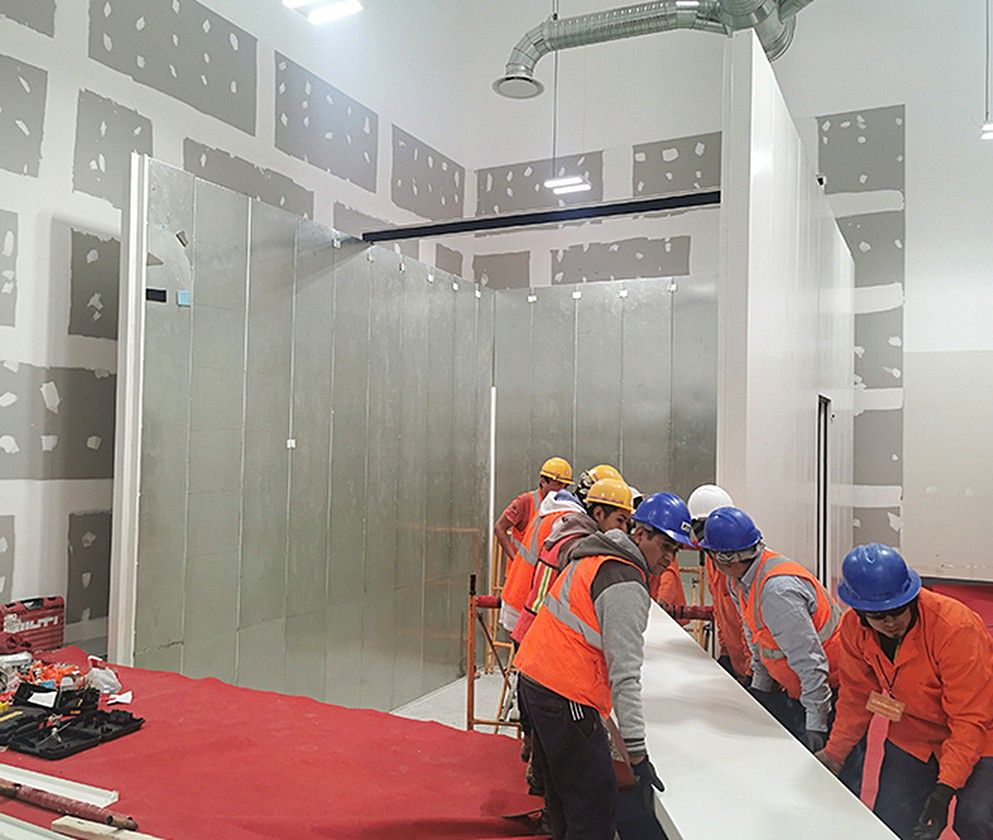
The design of an anechoic chamber begins by establishing the acoustic targets, including the free field frequency range, the noise floor, the free field deviation, and the test standard the room must satisfy. These targets govern every subsequent design decision, including the absorber structure, the room dimensions, and the isolation scheme.
The absorptive structure is the core of the chamber. Absorptive wedges are designed according to quarter wavelength theory, and their length determines the capacity for low frequency absorption, whereas a flat panel structure can achieve comparable results at a substantially reduced thickness. Whichever structure is adopted, the material must be environmentally sound, fire retardant, and stable in its absorption performance over the long term.
Isolation against both airborne noise and vibration is equally critical. A multilayer isolating envelope keeps external noise out of the room, while a floating floor and spring isolators interrupt vibration transmitted through the foundation. Doors, windows, ventilation openings, and cable wall penetrations are the weak points most prone to leakage and require dedicated sealing and silencing. Only when each of these elements is properly executed can a chamber that genuinely meets its specifications be achieved.